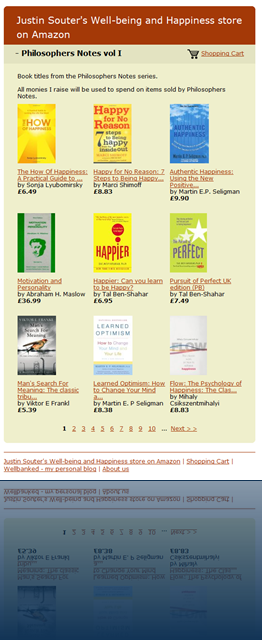
-- Business blog now available --

A quick note to say that I've set up my Business blog, to be able to speak with a clear voice on both personal and work issues (i.e. by having separate blogs).
Showing posts with label what'snext. Show all posts

Wednesday, 7 March 2018

Resources for a Teenager – SoundCloud

The seventh in a series of posts detailing those resources I’m finding useful on my own particular (life) journey.

Meta

Living in the sticks, I drive quite a lot. Given that we live in a digital time, I'm therefore fortunate to be able to 'make my own radio'.
In fact, I think I've been doing it since I had a mini-disc player, which was aeons ago! I either connect my device via bluetooth to the car radio, or else I plug the source into the audio-in socket. That source these days is most likely to be my Kindle Keyboard, which means I can listen to books read out loud by its text-to-speech feature.

The List


This list is from SoundCloud, which means that it's a series of interviews, thought pieces, and excerpts from longer recordings.


The rationale

  1. This is what a good life is: Jonathan Fields interviews Brené Brown in long form - ~50mins. We're the better for it.
  2. The Creative Life: I read Elizabeth Gilbert's book "Big Magic: Creative Living Beyond Fear". This is Jonathan's interview of Elizabeth.
  3. Hoping Others Fail Is Not A Strategy: I have enjoyed many of Jonathan's interviews and GLP Riffs, and this shorter piece asks - "What if you could go about it differently? What if you could reframe winning on both a deeper and larger scale?"
  4. The Killer App Is You: this seems pretty much eponymous, and is asking us to believe more in ourselves.
  5. Hacking Stereotypes: this is a tremendous story about a female founder moving heaven and earth to assist other women find a life path by giving them opportunities to write software - 'Talento tech femenino de Latinoamérica para el mundo'.
  6. Hearts Broken Open: how do we find the strength and the courage to heal when our hearts have been broken open? How do we let the love fall inside? A tall recounted by Parker Palmer.
  7. Hope: this is a lovely poem, and a resonant reading by Parker.
  8. Courtney Martin and Parker Palmer: the previous poem is read at the end of this illuminating interview by Krista Tippett. Krista and team are a gift to our world. Courtney articles something really powerful: "So I think even just to feel like you’re showing up as your whole self in different settings is a pretty rebellious act."
  9. Ray Chetty: I've included this as it was a privilege listening to someone who has intense attention to detail, who is a rounded and decent human being. Tyler is a great interviewer...
  10. Cass Sunstein: being a huge fan of behaviour economics, this was (and is) an enjoyable discourse through Cass's domain.
  11. The Woodcarver: fantastic that a Quaker should be relating a story from Chinese lore
  12. The Divided Life and the Quest for True Self: "Parker Palmer reflects on the consequences of living a divided life and the quest for wholeness".
  13. Standing In The Tragic Gap: a challenge for us to to stand in the place of uncertainty between how we'd like things to be, and how they really are. How do we stay there, but keep being vulnerable and open?

The Task

Too much of what we're told seems not to stand up to scrutiny, if we're able to find our own sacred place to stand.

How do we outgrow the needs of others, and loop back to them once we have learned to become that which resonates to our deepest selves. This is my snapshot as I posted this, but the challenge is the activity of a lifetime.

Feedback

Any thoughts, additions, amendments – whatever – please add in respectful and constructive comments below. Thank you!

Saturday, 13 January 2018

Resources for a Teenager – Atul Gawande

The third in a series of posts detailing those resources I’m finding useful on my own particular (life) journey.

Meta

I think these lectures – and the thinking behind them – are extraordinary.

I listened to them in the car on a couple of long journeys.

I’ve recently started reading Atul’s personal exploration ‘Being Mortal: Illness, Medicine and What Matters in the End’. It’s also excellent, and timely for me to read it.

The List


The rationale

I read Atul Gawande’s book ‘The Checklist Manifesto’ and loved it.

I thought it common sense but which hasn’t be common practice, until Dr Gawande’s efforts to improve global public health.

I was therefore delighted to learn that he would be delivering the BBC’s Reith Lectures.

I’ve copy-pasted the following info from the BBC’s website to save time etc.

Dr Atul Gawande - 2014 Reith Lectures

Atul Gawande, MD, MPH is a practicing surgeon at Brigham and Women's Hospital and Professor at both the Harvard School of Public Health and Harvard Medical School.

In his lecture series, The Future of Medicine, Dr Atul Gawande will examine the nature of progress and failure in medicine, a field defined by what he calls 'the messy intersection of science and human fallibility'.

Known for both his clear analysis and vivid storytelling, he will explore the growing importance of systems in medicine and argue that the future role of the medical profession in our lives should be bigger than simply assuring health and survival.

The 2014 Reith Lectures

The first lecture, Why do Doctors Fail?, will explore the nature of imperfection in medicine. In particular, Gawande will examine how much of failure in medicine remains due to ignorance (lack of knowledge) and how much is due to ineptitude (failure to use existing knowledge) and what that means for where medical progress will come from in the future.

In the second lecture, The Century of the System, Gawande will focus on the impact that the development of systems has had – and should have in the future - on medicine and overcoming failures of ineptitude. He will dissect systems of all kinds, from simple checklists to complex mechanisms of many parts. And he will argue for how they can be better designed to transform care from the richest parts of the world to the poorest.

The third lecture, The Problem of Hubris, will examine the great unfixable problems in life and healthcare - aging and death. Gawande will argue that the reluctance of society and medical institutions to recognise the limits of what professionals can do is producing widespread suffering. But research is revealing how this can change.

The fourth and final lecture, The Idea of Wellbeing, will argue that medicine must shift from a focus on health and survival to a focus on wellbeing - on protecting, insofar as possible, people’s abilities to pursue their highest priorities in life. And, as he will suggest from the story of his father’s life and death from cancer, those priorities are nearly always more complex than simply to live longer.

The Task

Atul Gawande strikes me as an outstanding role model.

Our challenge is to rise above our everyday conditioning and aim to be as good as Dr Gawande in the things that we are passionate about, and which bring us to life.

It’s easy to quote Ralph Waldo Emerson
"Do not go where the path may lead, go instead where there is no path and leave a trail."
The tricky bit is sailing towards the horizon and not knowing where you're going. It's spectacularly more difficult than you might expect...

As one of my Mentors said to me:
"Justin, it's not about leaving A to get to B, it's about leaving A"
Thank you Steve!

Goodreads

I endeavour to record what I’m reading via my profile on Goodreads.

Saturday, 6 October 2012

Brené Brown and wholeheartedness

Introduction


A quick post about a recent discovery I made, and grateful for the serendipity that brought me!

I recently gained a new Twitter follower, @kabbenbock, over at @souterconsults. I usually find out about new followers through an e-mail alert, and those with bios that resonate with me I check out, and follow back, as appropriate.

@kabbenbock IRL is Andy Smith, who I was aware of him as one of the authors of The Dragonfly Effect: Quick, Effective, and Powerful Ways to Use Social Media to Drive Social Change.

I felt flattered to be followed by someone like Andy, and checked out his Twitterstream before tweeting my thanks for the follow. One of his tweets was:

Kare Anderson’s article includes this quote:
Ironically, the sharing of one’s vulnerability with trusted others is one of the prime gateways to overcoming shame according to the star of one of the ten most watched TED talks, Brene Brown. In Daring Greatly, she describes the paradoxical power of embracing our vulnerability and acknowledging our fears as a path towards being more courageous and connected with others. That means letting go of the need for certainty and control.
This intrigued me, and I sought out Brené’s TED talk.

Brené Brown

The following is an except from Brené Brown’s bio page:
Brené Brown, Ph.D., LMSW is a research professor at the University of HoustonGraduate College of Social Work. She has spent the past decade studying vulnerability, courage, worthiness, and shame.  
Brené is a nationally renowned speaker and has won numerous teaching awards, including the College’s Outstanding Faculty Award. Her groundbreaking work has been featured on PBS, NPR, CNN, and has appeared in The Washington Post,Psychology Today, and many other national media outlets.

Her 2010 TEDxHouston talk on the power of vulnerability is one of most watched talks on TED.com, with approximately 5 million views. She gave the closing talk, Listening to Shame,  at the 2012 TED Conference in Long Beach. 

TED Videos

The videos are below. The first has now reached 6.1m views; the second is on its way towards 1.5m. Half a dozen of these combined views are from me! ;-)

The Power of Vulnerability


The blurb for this TED talk is:
Brené Brown studies human connection -- our ability to empathize, belong, love. In a poignant, funny talk, she shares a deep insight from her research, one that sent her on a personal quest to know herself as well as to understand humanity. A talk to share. (Filmed at TEDxHouston.)  

Listening to Shame


Blurb for this one is:
Shame is an unspoken epidemic, the secret behind many forms of broken behavior. Brené Brown, whose earlier talk on vulnerability became a viral hit, explores what can happen when people confront their shame head-on. Her own humor, humanity and vulnerability shine through every word.
IMHO even more powerful than the first talk. I love Brené’s admixture of vulnerability, insight, and joy. Thank you, Brené! :-D

I've put in YouTube versions of these talks as they're easier to tweak to fit in the blog design...

Videos for further context

I've gone a bit crazy with all these videos, but this for me is extraordinary stuff! Let me know if it takes an age to load...

TEDxKC - Brené Brown - The Price of Invulnerability


Shame & Empathy by Dr. Brené Brown


Resources

Check out Brené’s resources page for links to videos, podcasts, and online articles.

Books

I’m still in the early stages of exploring Brené’s work, however I’ve cued up Brené’s books on my Amazon wishlist:
  1. I THOUGHT IT WAS JUST ME (BUT IT ISN'T): Telling the Truth About Perfectionism, Inadequacy and Power
  2. The Gifts of Imperfection: Let Go of Who You Think You're Supposed to be and Embrace Who You are
  3. Daring Greatly

Podcasts

I’m a big fan of podcasts, and have listened to the Smart People Podcast interview with Brené. The first 5 minutes or so are context, which I’ve fast-forwarded when I’ve listened to the podcast again! ;-). Direct link

You may also want to check out this interview with Koren Motekaitis with is rather tremendous. Direct link.

Wholeheartedness

On of the key outcomes for Brené’s research has been that some people are what she calls “wholehearted” – in summary, they are confident that they are ‘enough’ and worthy of other people’s love.

I guess that’s the point of her writings, so I plan to read them after Loving What Is by Byron Katie, and Coming to Our Senses by Jon Kabat-Zinn. The books-to-read pile is growing! ;-)

Graphics

These are some graphics from Brené’s website which I am posting here to bring to a wider audience. I’m seeking to “be the change I’m trying to create”.


Wash up

I’m sharing these materials as they have resonated strongly with me. Whilst I’m keen to read all three books straight away, I sense that part of me is seeking in them “the answer” which I am coming to realise doesn’t really exist. I am confident that they will, however, be part of the solution!

I also like the idea that they are something to ‘move towards’, rather than ‘move away from’ – in the words of a buddy of mine. That puts Brené’s work in the same category as the positive psychology movement, in that it is creating new skills, rather than sorting out the past. Time to leave the past and create the future!

UPDATE 06/10/12: Added link for podcast interview with Koren Motekaitis.

Sunday, 27 May 2012

How can you learn greater well-being? What is Positive psychology? -- Some insightful concepts

Introduction

I was pleased to be able to attend another showing of the movie ‘Happy’ – hosted by Dr Deborah Jima-Otero at the Newcastle Centre for Positive Living, part of Northumbria University.

I was grateful to do this, as I had become aware of what I believe is some really insightful wording relating to positive psychology, in the context of a course run from October 2011 to help attendees improve their quality of life, and well-being.

Deborah kindly assented to me reproducing the wording – with the appropriate attribution.

Descriptive text from NCPL’s “Eight week programme in positive living”

This is verbatim from the course outline:
Dr Deborah Jima-Otero and Dr Matthew Lewis from The Newcastle Centre for Positive Living (NCPL) at Northumbria University are pleased to announce their eight week programme in positive living, starting on 20th October 2011 every Thursday 6.30-8.30pm, for members of the general public.
Leading people to positive lives
Using scientifically validated exercises from the field of positive psychology, the programme aims to introduce participants to techniques which will enable them to experience more positive emotions and flourish in life.   It will seek to help the group of participants to assess their personal well-being and satisfaction with life; plan a meaningful and satisfying life for themselves and try out various exercises which are aimed at increasing positive emotions and decreasing negative emotions.  These guided exercises will be completed during the weekly sessions and in the participants' own time between these sessions.

What are the benefits of positive emotions beyond ‘feeling good’?

Research has shown that positive emotions have a number of beneficial effects, beyond simply ‘feeling good’. 
Happier people:
  • Are more creative and better at problem solving – Positive emotions broaden people’s outlook, bringing more possibilities into view.  Greater openness makes them more creative as they are more likely to let go of preconceived ideas and think outside the box.
  • Are more productive and successful – They are more engaged both at work and play and tend to take less time off work due to sickness.
  • Are more resilient – They tend to bounce back from life’s setbacks more quickly.
  • Experience more fulfilling relationships with others - They are also more likely to help other people and benefit from social support themselves.
  • Are healthier – They tend to lead healthier lifestyles and research has shown that they even live longer!

What is positive psychology?

Positive psychology is at the heart of much of our work at the Newcastle Centre for Positive Living (NCPL).  In a nutshell, positive psychology is the scientific study of optimal human functioning and is concerned with positive aspects of human life such as happiness, well-being, flourishing, engagement, meaning, accomplishment, and positive relationships.  The aim of the field is to redress the imbalance that has emerged in the field of psychology from emphasising ‘misery and suffering’ (i.e., shortcomings such as depression, anxiety, drug addiction, schizophrenia and post-traumatic stress disorder) to understanding factors that make life worth living (i.e., potentials and human strengths).

Building ‘psychological immunity’

Positive psychology is keen to promote the idea that the full range of emotions have their place in human existence and that we need to give ourselves the permission to be human and accept that we all experience life’s ups and downs. So positive psychology is not about being ‘happy clappy’ but about being real.  However, it espouses the view that through hard work and practicing scientifically validated interventions (and experiencing setbacks along the way!)  individuals can learn resilience and build up their ‘psychological immune system’.  The idea is that, like physical immunity, individuals with a strong psychological immune system may still ‘get sick’ but this happens less frequently and when setbacks occur they get over them more quickly.

Prevention through cultivating the positive

Positive psychology is not targeted at fixing problems (i.e. remedial) but works on getting people to their upper range of well-being.  If you imagine a scale of well-being ranging from -10 to 0 to +10, psychology has traditionally focused on getting people who may be a -8 on the scale up to 0 or 1.  Positive psychology, by contrast, also focuses on those who may be at 0 or +1 or +2 and teaches them how to get to +8 or +10.  It helps individuals who may be ‘getting by’ in life to truly flourish, find meaning, and build resilience. In this respect it is much more preventative in its approach.  For example, Martin Seligman the founder of the field of positive psychology, has found in his research that learning optimism prevents depression and anxiety in ‘at risk’ children and adults, roughly halving their incidence over the next two years.
also
Finally, we would like to point out that you may find this course personally challenging at times as it may involved changing deeply entrenched habits. We do not advocate the view that there are a few ‘easy steps’ to happiness. Instead, we believe it takes commitment, motivation and hard work. We aim to support and encourage you on this journey but ultimately the main drive and effort needs to come from you. That said, you also need to accept that you will experience challenges and setbacks along the way – these are all part of being human!

Take away

Key points for me:
  • Well-being and meaning is something that can be developed and grown – chiming with my recent reading of ‘Mindset’ by Carol Dweck, and ‘Bounce’ by Matthew Syed
  • Well-being and happiness is about being authentic, and raising one’s “mean” state of experience
  • Going through the exercises is personally challenging
  • I really like the idea of a “psychological immune system”
Arguably these are incredibly important life skills that many more people would benefit from, and deserve to be part of a wider set of life skills courses that form part of everyone’s basic education. What do you think?

Thursday, 19 April 2012

“What are the skills that build positive emotion, gratitude, optimism, purpose, engagement in life?”

Intro

Since last June, I've been working with a start-up called http://happie.st. Our tagline is 'get rewarded for doing the things that make you happy".

I've come across some awesome personal development materials since then, and have got stuck into a lot of podcasts, DVDs, books, articles etc. ;-). For the eagle-eyed, you probably already know that! lol

This post records some of my recent discoveries, and the inspiration they provide:
  • Some reflections by Martin Seligman, arguably the moving spirit behind Positive Psychology, and someone I first learned about on my Psychology undergraduate degree – as he had convincingly put forward the theory of ‘learned helplessness’.
  • A summary from Time magazine about Positive Psychology
  • Links to some courses on Positive Psychology I have found (in the UK)
  • Widget showing some of my Goodreads books and account

Marty Seligman

I find listening to a podcast of someone gives a fantastic flavour of the person, and whether I’m going to enjoy / like / benefit from their writings.

Marty at the RSA

Martin Seligman at the RSA in London: I've listened to his podcast, and it’s highly insightful and enjoyable. Full disclosure: I used to be a Fellow of the RSA.

MAPP programme promotion podcast

Having searched iTunes for ‘Martin Seligman’, I was also listening to another podcast, and found the early proceedings highly meaningful.

I’ve listened to a particular section a number of times, and I've (roughly) typed up a couple of minutes the proceedings of the Virtual Information Session (http://www.sas.upenn.edu/lps/graduate/mapp) from about 4mins 30secs - involving Marty Seligman:
  • "Back 8 years ago, when I found myself president of 160k psychologists, I asked myself the question "what do psychologists do well?", "what don't we do well?"
  • I thought what we did pretty well was suffering: depression, trauma, anxiety, anger, victims and the like
  • But, what psychologists didn't do well, what there was no science, no practice of, was what makes life worth living: positive energy, positive emotion, engagement
  • So, as I looked around, I decided that my initiative as president of that Association would be to cheer-lead for, raise money, do some of the science, or the possibility of a science of practice, on what makes life what worth living, the positive side of life
  • I should say that what was behind that was some of my experience as a clinical psychologist, as a therapist for many years
  • And initially, I had believed that all you needed to work on was suffering; if you got rid of suffering, you automatically got happy
  • We were astonished to find out in clinical practice that occasionally when things went really well and you were able to alleviate anxiety, depression, anger: you didn't get a happy person, you got an empty person
  • So the question was, so what are the skills that build purpose and meaning in life, they're different from relieving depression? What are the skills that build positive emotion, gratitude, optimism, purpose, engagement in life? And so that became my mission
  • [...]
  • Starting about 4 / 3 years ago, as the science was beginning to develop along, I began to become concerned about application; that is, how can we take the things we're learning about gratitude, about pleasure, about strength and virtue, about creating purpose, and bring them into the real world"
I feel the point about an 'Empty person' is incredibly powerful, certainly for my own life. I'd actually bought 'Learned Optimism' (http://amzn.to/J6djq7) a couple of weeks back, and I'm also reading 'Happier' (http://amzn.to/Jrve7w).

I feel that this will be a rich vein for investigation and learning for me. I find the description of ‘empty’ a trigger to do practical things to build my own levels of positive emotion, gratitude, optimism, purpose, and engagement in life :-D

I'd be fascinated to hear any thoughts and feedback you may have. By the way, MAPP stands for ‘Master of Applied Positive Psychology’.

Courses

For now, studying at the University of Pennsylvania, at Martin’s knee, is a bit of a long shot, so here are some closer to home:

Time document

Useful summary of Positive Psychology which puts things into a nutshell:
The New Science of Happiness

Goodreads widget

I’m whacking this in here, as it’s a useful place for me to share what I’m reading :-)


Wash up

I hope you find these materials useful and insightful. I’d love to get your feedback, and what else you’d suggest. Thanks for reading!

Wednesday, 29 February 2012

Well-being materials

Introduction

I’m also posting supporting materials to accompany the recent event where I was part of a group which showed The Happy Movie.
I’m also posting some supporting materials, which I will update in a couple of weeks – I want to get this all live before it gathers dust! ;-)
I seem to have got over-excited by embedding stacks of videos in this post, so I hope you like it!

Happiness videos from TED.com

Some of my favourites in this area.

Action for Happiness

Check out Action for Happiness for things happening this realm, in the UK. Their resources are available here.

Books

"The Power of TED*" by David Emerald, "You can have what you want" by Michael Neill, both books in my Amazon Store.

Wash up

Super-quick post that I hope to build on in future.

Philosophers Notes goodness

Introduction

I’m also posting supporting materials to accompany the recent event where I was part of a group which showed The Happy Movie.
I’m also posting some supporting materials, which I will update in a couple of weeks – I want to get this all live before it gathers dust! ;-)

Philosophers Notes

I’m a big fan of PhilosophersNotes, and whose videos I’m embedding below. Masses of powerful ideas for personal development and growth, and inspirational and uplifting when that’s what’s required.
I feel comfortable that Brian Johnson (see videos) is a genuine and authentic guy, and there’s a tremendous amount of learning that he’s sharing.

YouTube videos

Some of my favourites:

Books

image

Meditation materials

A short explanatory video:


I’ve been listening to a couple of these for the last several weeks – usually when I woke up, and as I go to bed. Helpful, in a low-key way.

Power of TED*

When I watched this video, there was a ‘kaboom’ moment. I’ve found this book (and related material, and coaching course) incredibly helpful.

In Brian’s words, “I hope you dug it”.

Happy Movie press release


Introduction

I’m also posting supporting materials to accompany the recent event where I was part of a group which showed The Happy Movie. This is the press release we prepared. Links etc. in the final section.

PRESS RELEASE

Issued: 27 January 2012

POP-UP CINEMA BRINGS GLOBAL ‘HAPPY’ EVENT TO THE NORTH EAST

clip_image002
A merry band of happiness promoters is bringing the documentary film, Happy, by Oscar nominated Director Roko Belic, to the North East. It will be screened for one day only at a ‘pop-up cinema’ at the Centre for Life, Newcastle on World Happiness Day, February 11th. On the same day the film will be enjoyed in communities across the globe, from Sao Paulo to Singapore as people celebrate what it means to be happy, who is happiest and how we can contribute to the happiness of others.
Despite the credentials of the Director, the film does not currently have a distribution deal through cinemas and can only be seen at special screenings like this one. It is being hosted by a small group of North East based supporters of happiness, wellbeing and positive psychology who hope it will inspire viewers to join them a new movement to promote happiness in the region.
With real-life people and stories, the film brings to life the findings of most happiness and wellbeing research which shows that good family, social and community relationships, rather than wealth and status, are what really make us happy. Roko Belic learned a lot about the nature of happiness and what is important in life while making the film. He said,
“I learned something simple but completely illuminating. Research showed that just about all happy people have strong relationships. They are healthier and have happier children. They are more likely to find a creative solution to a problem and to help a stranger in need. Happy people have fewer conflicts and are less likely to commit crimes, pollute the environment or go to war. In other words, just about everything I cared about, everything I wished I could change in the world, was improved with being happy.”
“The greatest lesson I learned while making this film is that my pursuit of happiness is not about me. It's about our relationships and how we help each other. It's about us.”
Paul Hemphill, one of the organizers of the Centre for Life screening said:
“Our event will be so much more than a typical cinema screening. The doors will open an hour beforehand for the chance to chat and make new friends over a drink. And then afterwards, for those who want to stay, there will be time to discuss the film with a panel of local experts. We hope that the whole event will be an incredibly rewarding and potentially life changing experience for everyone who attends.
Tickets to see the film should be bought in advance online and cost £10 or £7.50 (concessions) from Eventbrite.com. The doors open for the matinee screening at 2pm and for the evening screening at 6:30pm.
##Ends##

Notes to editors

1. The organisers of the event in Newcastle are five small business owners with interests in coaching, personal development, training, wellbeing and organisational improvement. They are; Mike Cockburn (Sogno), Paul Hemphill (Horizons Coaching), Jan Etoile (Etoile Enterprises), Justin Souter (Souter Consulting), and Emily Sweetman (Emily Sweetman Limited)

Contact details:

Mike Cockburn: @mikesogno
Paul Hemphill: @HorizonsLife
Jan Etoile: @etoileenterprises
Justin Souter: @justingsouter
Emily Sweetman: @emzo1968
2. The quote from Director Roko Belic is taken from an article in the Huffington Post:
http://www.huffingtonpost.com/roko-belic/happy-documentary_b_1220111.html
3. World Happy Day 11 February 2012: “World HAPPY Day inspires action for increasing happiness in our own lives and in the world. A growing body of research shows that happy people are healthier and live longer. They are more likely to care for the environment and less likely to commit crimes or go to war. Happy people help others more often... and are more likely to find creative solutions. Increasing happiness benefits us as individuals and communities in infinite ways and is a goal worth sharing.” See http://www.worldhappyday.com/
4. The film Happy combines cutting-edge science from the new field of positive psychology with real-life stories of people from around the world whose lives illustrate these findings. We see the story of a beautiful woman named Melissa Moody, a mother of three who had a “perfect life” until the day she was run over by a truck. Disabled for nine years and disfigured for life, amazingly she is happier now than before her accident. Manoj Singh, a rickshaw puller from the slums of Kolkata, India who lives in a hut made of plastic bags with his family, is found to be as happy as the average American. Through these and other stories HAPPY leads us toward a deeper understanding of how we can all live more fulfilling, healthy and happy lives. See http://www.thehappymovie.com
5. Screenings take place at 3pm (Doors open 2pm) or 7.30pm (Doors open 6:30pm) at Centre for Life conference centre, Newcastle on Saturday 11 February 2012. Tickets cost £10 or £7.50 (concessions). Matinee tickets from http://happynortheastmatinee.eventbrite.com and evening tickets from http://happynortheastevening.eventbrite.com/
6. This Happy movie press kit includes biographies and photographs
www.thehappymovie.com/files/HAPPY-Press-Kit.pdf

Happy Movie - reflections

Intro

This posts details how we got on at the Centre for Life with our matinee and evening showings of The Happy Movie.
I’m also posting some supporting materials, which I will update in a couple of weeks – I want to get this all live before it gathers dust! ;-)

Centre for Life = fantabulous

I’d firstly like to say how grateful we are to the Centre for Life and their team, led by Owen, who did a tremendous job making everyone feeling welcome and putting on the show without a single glitch – bravo!

Photos

I took these before everyone arrived. We sold 20 tickets for the matinee, and nearly 40 for the evening. Happy times! :-D

Discussion sessions – interesting thoughts / quotes

It’s them what came that made it

We had a great bunch of people who came, watched the movie, and discussed their thoughts afterwards. We had some really interesting points made, mainly around communities rather than individual happiness. The following sections represent a sample of them.

Afternoon

  • “I’d sacrifice the pawn to save the queen any day”
  • “There’s no one key to happiness, it’s different for everyone”
  • Concerns about the lack of community in our Communities; and a related discussion about the Diamond Jubilee – it doesn’t matter what you think of the Monarchy, “the point is to have the party”
  • Targets / key performance indicators in schools – “measurement kills happiness”
  • We talked about the concept of ‘Pay it Forward’
  • A passionate point about giving children the chance “to be aware”
  • It was felt that managers in any organisation could be kept ‘grounded’ by having them rolling up their sleeves and often working with customers and front-line staff

Evening

  • A quick discussion about choosing to be happy
  • We discussed meditation, e.g. mettā bhāvanā
  • “After a week on my own, I craved the company of other people”
  • Our focus also took in random acts of kindness [see also The Kindness Offensive]
    • There was a great point made – if  you’re doing random acts of kindness, then you’re more likely to notice them in other people
    • Check out this awesome London Underground site which document stories of kindness :-D
  • “If you’re looking for good things, you’re more likely to see them”
  • We talked through the difference and relative merits of experiential versus existential happiness – i.e. is happiness something that can be built and increased, or is it something that is innate?
  • “it’s about the acceptance of yourself”

My thoughts

  • The movie is quite challenging: in a constructive way
    • We all have our preconceived ideas, and it’s healthy to have them compared to other perspectives, and ways of living
    • Amazing to watch a rickshaw puller, living with his family in a shanty - who is obviously a very happy person, and lives in harmony with his neighbours
  • Not everyone is thinking “how can I be happier – or more fulfilled?”; I was instructive to remember that “nobody is broken, and nothing needs fixing”

Thanks to my colleagues

Whilst I don’t wish this post to turn into a schmaltzy love-in, however I’m really grateful that we as a group were able to make this happen, and share the movie with the North East. So, credit where it’s due to:
Mike Cockburn: @mikesogno
Paul Hemphill: @HorizonsLife
Jan Etoile: @etoileenterprises
Emily Sweetman: @emzo1968
Onwards!

Friday, 3 February 2012

Join us for the North East Premiere of 'HAPPY' on World HAPPY Day

Background

You may be aware that I’ve been working at happiest Limited since last June. I feel very fortunate to have learnt a great deal, and discover a treasure trove of resources around the practice of happiness. I.e. that one’s level of happiness and well-being is something that one can grown, through regular practice and habitual behaviour.
This post provides the context to a happiness-related event I’m involved in organising in Newcastle upon Tyne, and invites you to attend and bring your friends!

Happiness at Work event

I was thrilled to attend the recent Happiness at Work event, organised by Codeworks:
This month we’re taking a different approach to our Think and a Drink event with the topic of Positive Psychology and its effects in the workplace.  We’ve got speakers and discussions and even a chance of taking part in some of the very first research studies on the subject with our friends at Northumbria University.  Here’s a little taster of what you can expect.
Positive Psychology is a new branch of Psychology which focuses on enabling people to grow and fulfil themselves. Professor Martin Seligman, who is generally credited with igniting the interest in positive psychology when he was appointed President of the American Psychological Association in 1998, describes it as enabling people to ‘flourish’. A positive psychological state in which we feel positive emotions, engagement, achievement, positive relationships and a sense of meaning in our lives.
Research also demonstrates that a positive psychological state seems to protect against illness and prolong longevity. It also enhances resilience, very important given the challenging and unpredictable economic climate we are experiencing.
At that event, the seeds of local action were sown, so please read on for details of the event in February.

We’re showing a movie, and you’re invited!

We’re showing a movie on 11th February in Newcastle upon Tyne. Once in the afternoon, and for the second time in the evening. Please use these links to book online.
The following is the descriptive blurb:

Happy People = Happy World

On World HAPPY Day, February 11, 2012, thousands of people will join together in communities across the globe to watch the film HAPPY and begin their journeys toward healthier, and happier lives. We want everyone in the North East and Cumbria to be part of this amazing, worldwide event so we are screening the film twice, at 2.00pm and 6.30pm, at The Centre for Life in Newcastle.
World HAPPY Day inspires action for increasing happiness in our own lives and in the world. Research suggests that happy people are healthier and live longer, they are more likely to care for the environment and less likely to commit crimes or go to war. Happy people help others more often and are more optimistic and creative. Increasing happiness benefits us as individuals and communities in infinite ways – it is a goal worth sharing.
Roko Belic, director of the Academy Award® nominated “Genghis Blues” now brings us HAPPY, a film that takes us from the bayous of Louisiana to the deserts of Namibia, from the beaches of Brazil to the villages of Okinawa to explore the secrets behind our most valued emotion.

Screening Programme

Afternoon
2.00pm ‘Happy Networking’ – an opportunity to relax over a drink, catch up with friends and meet lots of new, like minded people
3.00pm ‘HAPPY’ – be one of the first in the North to experience the inspiring new film by Roko Belic
4.30pm ‘Happy talk’ – share your feelings about the film, learn more about the psychology and growth of happiness and find out more about forthcoming Happiness events, including the foundation of a Happiness group in the region.
5.30pm Event draws to a close
Evening
6.30pm ‘Happy Networking’ – an opportunity to relax over a drink, catch up with friends and meet lots of new, like minded people
7.30pm ‘HAPPY’ – be one of the first in the North to experience the inspiring new film by Roko Belic
9.00pm ‘Happy talk’ – share your feelings about the film, learn more about the psychology and growth of happiness and find out more about forthcoming Happiness events, including the foundation of a Happiness group in the region.
10.00pm Event draws to a close

The Film


Happy - A Documentary Trailer from Wadi Rum Films on Vimeo.
For more information about ‘HAPPY’ go to - http://www.thehappymovie.com

How you can get involved

Please come and join us – the links again: afternoon and evening. Come to both if you like ;-). Key activities:
  • share your feelings about the film,
  • learn more about the psychology and growth of happiness and
  • find out more about forthcoming Happiness events, including the foundation of a Happiness group in the region.

Friday, 26 November 2010

NLP Practitioner – first impressions

Introduction

I’m putting this post together after completing the ‘Practitioner’ course of Neuro-Linguistic Programming (NLP), which finished on Monday.

[I’ve made extensive use of links to NLP-related articles on Wikipedia – which has a suite of pages addressing the gamut of issues in this area.]

Preconceptions

I must admit that I’m pretty sceptical of people who profess to turn your life around like Tony Bobbins (ok, so it’s a spoof), and I’m not really a big fan of TV hypnotists and Vic Reeves-style “I Will Cure You” stuff.

Loose impressions I’d picked up about NLP included such tropes as ‘vulcan mind control’ and something to do with the Dark Side. ;-D

My background

Perhaps this is all a bit of an amorphous mass of my own preconceptions, but I’m a psychology graduate, and have an interest in self-improvement and have read up about skills like Emotional Intelligence and assertiveness (amongst others).

The course itself

You should be able to find more information about the course from this link, but essentially it was about providing a practical introduction to skills that attendees could use for improving self-awareness and communication with other people.

Tutor and assistants

The course was run by Kay Cooke of The ME Group in Hexham, Northumberland. Kay is an accredited NLP Trainer, and was assisted by presence of a revolving team of Master Practitioners (i.e. people trained with skills to assist other people [my typology]).

Structure

The course comprised two 4-day clusters, run from Friday morning through to Monday night (i.e. over the weekend). Hours were 9.30 until 4.30-5 o’clock.

At times it was quite full-on, and was pretty much a synthesis of best practice tools and techniques for communication (e.g. “Deep structure and surface structure” from Noam Chomsky). There was a combination of theoretical learning, and practical exercises (e.g. visualisation) both with Kay and between other members of the group.

The Group

It was a small group of 5, with 3 men and 2 women. Ages ranged from late teenager to middle-age {I think I can get away with that! ;-)}.

I think the small group worked well – there is a lot of material to cover, and a larger group might well be more difficult for the trainer to optimally instruct.

Impressions

My over-arching feeling was that Kay draws upon a deep well of learning, training and personal insight to deliver a (potentially) tricky subject very adeptly. She made it look ‘simple’ when that’s definitely not the case.

When I questioned her about the wider context that NLP sits in (i.e. how we all live, in our different ways) she posited that NLP material is ‘simple’, and in many ways I would agree with her. However, NLP material definitely challenges many implicit and unconscious assumptions we all make about living.

What’s working for you, what would you like to change?

Kay made clear that the NLP framework is just that – a framework. If you’ve got things in your life which are going well, great: but if you’ve got stuff you’d like to work on, then NLP might be able to help.

There was also an ongoing discussion about process versus content: in that what I might call ‘traditional’ / ‘talking’ therapies, the therapist and client talk through issues; whereas NLP typically keeps content out of the interaction and seeks to come to a different perception of issues and events, in order to influence how the client’s subconscious is dealing with them.

Importance of ethical dimension

One of the things I struggled with at first was how one might be able to use powerful tools and techniques in such a way which was responsible and ethical. The penny dropped during the second 4-day cluster, in that:
a) I was only training for the Practitioner level, so interventions with other people were probably beyond my skill level, and
b) the ethical context was using NLP is / was absolutely crucial

I think this boils down to only ‘helping’ people if they ask to be helped, and—even then—closely observing the person to ensure any assistance was appropriate and that the flow of any intervention closely matched the situation. If you take someone on a ‘journey’, you’ve got to be able to bring them back, as it were…

Conclusions

Why the controversy?

The two founders of the NLP movement had a falling-out, and in compiling this post, I became aware of the extensive controversy surrounding NLP (e.g. vis-a-vis science).

Kay’s training is validated by The Society of NLP (logo to the right).

Whilst I understand that people often have very good reasons to get heated about things, personally I found the material pretty insightful and resonating (although not sure what that says about me! ;-D).

Part of the toolkit

Viewed in the context of many other ways of seeing the world, I felt it was an entirely legitimate subject area, and useful addition to the canon of self-improvement activity.

‘Everything in moderation’ is a useful dictum, and I personally gained some useful insights and elements of new self-awareness. What’s so bad about that? I’m still waiting to learn the vulcan mind control techniques <sigh>.

So, a summary of my first impressions. Doubtless there will be others, and I will do my best to post them here. :-)

Wednesday, 4 August 2010

Crowdsourcing Mycological Response Teams to help with the Gulf #oilspill?

Introduction

In my previous post on this subject, I recapped my personal take on the overall situation.

Having drafted this posted a couple of days ago, I now learn that:

Almost three-quarters of the oil spilled in the Gulf of Mexico has been cleaned up or broken down by natural forces, the US government has said.

A government report says only a quarter of the oil from the BP well remains and that it is "degrading quickly".

The majority had been captured, burned off or evaporated, it states. But more clean-up is necessary officials warn.

The report was released after BP announced its "static kill" procedure to seal the leak was working.

So I thought I’d better post in case something else major happened. Doh!

Challenges

I’m guessing that despite the good news re the oilspill, that there will remain a challenge to clean up that oil which hit the Gulf coast.

Having pinged an e-mail to Paul Stamets’ team, their response pointed me to a page with the following quote:

The Petroleum Problem

Thank you for visiting fungi.com, and for your interest in the BP oil spill disaster and the potential for mycoremediation.

We are being inundated with requests and cannot individually address all of the questions we have received. We are in direct dialogue with the EPA at the highest levels, and are teaming to implement solutions to this huge disaster. Since we are such a small company, we are stretched to our limits. Your support allows us to dedicate as many of our resources as possible, and for this we thank you. Again, please accept our apologies if we cannot individually address your concerns. Our statement at below will be updated periodically as we gather more information.

[my hyperlink for mycoremediation btw]

I am assuming that Paul Stamets and his team are the primary resource in this domain – i.e. to use fungi to break down pollutants in an ‘eco-friendly’ way. What seems clear is that there are problems with scaling, getting the idea to a wider audience and gaining a following & critical mass.

The article continues:

How can we help?


Knowing that the extent of this disaster eclipses our mycological resources should not be a reason to not act.

I proposed in 1994 that we have Mycological Response Teams (MRTs) in place to react to catastrophic events, from hurricanes to oil spills. We need to preposition composting and mycoremediation centers adjacent to population centers. We should set MRTs into motion, centralized in communities, which are actively involved in recycling, composting and permaculture—utilizing debris from natural or man-made calamities to generate enzymes and rebuild healthy local soils.

I see the urgent need to set up webinar-like, Internet-based modules of education to disseminate methods for mycoremediation training so people throughout the world can benefit from the knowledge we have gained through the past decade of research. Such hubs of learning could cross-educate others and build a body of knowledge that would be further perfected over time, benefiting from the successes and failures of those in different bioregions. The cumulative knowledge gained from a centralized data hub could emerge as a robust yet flexible platform that could help generations to come. Scientists, policy makers, and citizens would be empowered with practical mycoremediation tools for addressing environmental disasters.

Going social

My argument here is that a social approach, akin to the PeopleFinder wiki created in response to Hurricane Katrina, might help MRTs self-organise and conduct operations under a loose ‘umbrella’.

A similar tool might already have been implemented by Deepwater Horizon Response website – but apologies – I’ve not had time to check it out (or the follow-up site RestoreTheGulf.gov).

Tooling

I’m going to kick speculation about what tools to use into touch for now, as my priority is to post – and update this or post separately as appropriate. However, potential requirements could be:

  • Repository of successful mycoremediation techniques
  • Communications tools
  • Team-based areas where teams can get themselves sorted and manage their activities
  • Connections with mainstream social media tools

Staci Stoller

I wanted to tip my (Stetson hat) to Staci Stoller, a former colleague of mine in London, who has offered to help in getting the message out in Texas. Thanks, Stace! :-)

The Wendy Schmidt Oil Cleanup X CHALLENGE?

I saw an item on the BBC news site, which took me through to the main page on this, which explained thus:

It is a $1.4 Million competition designed to inspire a new generation of innovative solutions that will speed the pace of cleaning up seawater surface oil resulting from spillage from ocean platforms, tankers, and other sources.

This X CHALLENGE, announced on July 29, 2010, is a one-year competition that begins on August 1, 2010 and culminates in the summer of 2011, with head-to-head competitive demonstrations taking place at the National Oil Spill Response Research & Renewable Energy Test Facility (OHMSETT) in Leonardo, New Jersey, USA (www.ohmsett.com).

A $1 Million Prize will be awarded to the team that demonstrates the ability to recover oil on the sea surface at the highest oil recovery rate (ORR) and the highest Recovery Efficiency (RE).

So, my initial excitement about something fungi-related winning the prize was tempered by the focus on “cleaning up seawater surface oil”. However, on the ‘competition details’ page I also noticed:

X PRIZE will be finalizing the details over the next 30 days, and will post final rules in September.  We encourage you to PRE_REGISTER as a team and we will keep you informed of any changes and when the detailed rules are posted.

So maybe the scope of the compo could be widened to include prizes for on-shore cleanup efforts?

Wednesday, 19 May 2010

Paul Stamets @ TED on fungi; also re how they can help clean up Gulf oil spill

Introduction

I first discovered Paul Stamets when reading this article on my Palm III via AvantGo (a forerunner of RSS) – waaay back in 2002.

I was particularly struck by the effect of fungi in cleaning up soil contaminated with diesel – as told in this Wikipedia article about Mycoremediation.

Eventually, as per this previous post – I bought some wooden dowels, innoculated by fungi from Paul’s company, and set up a large log with them in. Rather embarrassingly, I never moved the stump from one house when Caroline and I moved – it got left my the wayside as it was too heavy / I was too embarrassed to ask the movers… :$

I also bought a copy of Paul’s book Mycelium Running: A Guide to Healing the Planet through Gardening with Gourmet and Medicinal Mushrooms but that’s also still on the to-do pile. Ho hum!

Rediscovering Mr Stamets

*Anyway*, I was reading The Whuffie Factor: Using the Power of Social Networks to Build Your Business by Tara Hunt last week, and she mentioned being introduced to Paul when she was at TED. So I googled Paul’s talk and found it – see below (I think he really nailed it, although there was a cheesy joke at the beginning lol).

The citation from the TED website reads:

Entrepreneurial mycologist Paul Stamets seeks to rescue the study of mushrooms from forest gourmets and psychedelic warlords. The focus of Stamets' research is the Northwest's native fungal genome, mycelium, but along the way he has filed 22 patents for mushroom-related technologies, including pesticidal fungi that trick insects into eating them, and mushrooms that can break down the neurotoxins used in nerve gas.


Video

He’s obviously a rocket scientist, but what he says is compelling!

Paul Stamets’ statement on Mycoremediation and its applications to oil spills

So, having found Paul’s talk, it got me thinking that his expertise might be helpful in mitigating the effects of the Gulf oil spill. I then got in touch with his company, and they forwarded the statement below:

Paul Stamets statement on Gulf oil spill

What Paul is saying is that fungi could provide a natural remedy to break down the oil and mitigate its long-term effects, but there would need to be an army of people on the ground to make it work in practice…

I think most people would put this in the “it’s so crazy, it just might work” category – but I’m putting this out there in the hope that it might get some legs. In fact, I might well send the link to the Deepwater Horizon team…

Thoughts?

Thursday, 15 October 2009

Gastroscopy

I’m posting this bunch of bullet points as is, otherwise this ain’t going to get posted at all… :-s

I’ve got a photo of my duodenum, but need to find it and scan it…

Cast

  • Pam, the super efficient ward sister with the excellent bedside manner
  • Lesley, the lady with the scanner (radiographer??)
  • The good Doctor
  • Caroline – who took me
  • My Mum, who picked me up

Chronology

  1. Admittance into Gastro-enterology
  2. Own cubicle, cubicle’s own hand wash
  3. Explanation of choice between
    1. Throat spray
    2. Sedation
  4. Explanation of procedure
  5. Chose throat spray
  6. Doctor arrives, I sign disclaimer
  7. Go into ‘operating room’
  8. I marvel at the gastroscopy equipment
    1. Looks like something out The Matrix 
  9. Doctor gives me throat spray
  10. Bed, turn on my left hand side
  11. ‘Bit’ to go between my teeth – aargh!
    1. It’s a plastic thing with a hole big enough to have the ‘camera’ put through it, and so you don’t damage the equipment by biting on it - yeeuch
  12. Gizmo fed into my mouth
  13. Deep breathing, steady breathing
  14. Suction thing like dentists
  15. Swallow
  16. Swallow again
  17. Gizmo into my stomach
  18. Further down, into duodenum for a look around
    1. Makes me feel a bit sick
  19. Air being pumped in makes me burp a lot
  20. Gizmo used to take samples – duodenum
  21. Back into stomach for a look see
  22. Concern because of saliva & breathing
  23. Back out again
  24. Thanks heavens!
  25. Lesley gives me photo
  26. Recuperation
  27. 45 minutes after spray
  28. Mum comes to collect
  29. Rather tired last night
  30. Have a sore throat today – unsurprisingly. Rather like a ‘sore throat’ caused by illness.

Initial test results

The biopsy taken from my duodenum was put into some ‘agar jelly’ containing lactose, along with a colour indicator. Apparently those with lactose intolerances normally turn the indicator a sky blue colour. I managed to turn it navy blue, which means a severe lactose intolerance.

The good Doctor also mentioned I have mild gastro-oesophageal reflux disease (apparently). Although looking at the symptoms, I don’t seem to suffer from this…

Results of blood test? Need to recall / check documentation

Reflections

  • Would have been good to have some kind of hand signals to communicate
  • Lack of control
  • Anxiety over pipe in mouth, & breathing
  • Throat spray vs. sedation

Deep joy – not.

Monday, 1 June 2009

GoodReads, LibraryThing, Shelfari, or WeRead?

I’ve read a few cyberpunk and popular science books over the last few years, and I thought it’d be fun to catalogue them online and see whether there were folks who might suggest close matches to the micro-genres I’ve enjoyed.

To that end, I started looking around for websites that might provide this service.

This should probably be seen in the context of similar searching a while back, which lead to checking out Collectorz to catalogue my CD collection [so last century I know! ;-)].

  • GoodReads
    • Second most established
  • LibraryThing
    • Seems to the most established
  • Shelfari
    • Owned by Amazon (altho others get book data from Amazon)
  • WeRead
    • Is this the most recent of the 4

Links

A google search for comparisons of the four yielded these:

However, this post looks like the clincher. I have therefore signed up with this account at GoodReads.

CueCat

Whilst checking out Collectorz, I found that one can scan the barcode of the CDs (and hence books) to more rapidly upload the details to the Web / desktop application.

The scanner of choice seems to be CueCat. Initially LibraryThing had this post and I thought LT would be the way to go. Happily this help item on GoodReads shows GR do the same, so CueCat is now on my birthday list!

If I go with Collectorz for CDs, I will let you know. I see there is discussion on GR re cataloguing CDs, but it’s not mainstream.

Thursday, 28 May 2009

Where we live

WAH - my Office ;-)I wanted to write a brief paean to where we live, as we have enjoyed it so much.
Unfortunately we are moving when our lease expires in July because of circumstances beyond our control. So I thought I’d post whilst the going was good.
You’ll find a fair few photos of the countryside around where we live via my Flickr account.
My home office
We used to live in North Shields, so to move out into the lovely Northumbrian countryside has been a literal and metaphorical / metaphysical breath of fresh air. :-D
Other plus points is that where we live:
  • It’s not too far from Newcastle upon Tyne: about 30 mins from the Metrocentre & central Newcastle
  • It’s good for mountain biking
    • I can hit the country roads and green lanes from straight out the back door
    • It’s closer to Kielder forest, where there is all manner of cross country mayhem courtesy of Kielder Trail Reavers
  • There’s a brewery half a mile away, which we can drink at the the Black Bull
  • It’s nice and quiet and it gets pretty dark in the evenings (if the light from Newcastle & Gateshead doesn’t reflect off the clouds)
  • Towards the North West, the sky at night is very clear and it’s possible to see some amazing stars (and a few shooting ones)
  • There is a varied slew of wildlife out and about, including:
    • Deer
    • Bats
    • Cows / Sheep
    • Kestrel
    • Badgers
    • Foxes
    • Mice
    • Song birds
    • Toads
    • Sundry insects
    • Rats
    • Feral cats
    • All manner of birds
    • There’s a few horses knocking about, too
More of Jarvis' garden ;-)Jarvis, our dog, loves it as he chases the pheasants, partridges etc. that lurk in the cover around and about. We get to walk him in various places, which keeps us fit, too.
There *are* downsides:
  • Winter can lasts for 4-5 months, can we windy, wet & snowy; it can be expensive to run an oil-fired central heating system
  • Broadband is pretty hopeless – we’re at the end of a 9km line, at the limit of usability really
  • The pigs being reared next door can get a bit smelly!
So that’s it. We’re hoping to move down the road, so watch this space.
UPDATE: This is new house [ok, so it’s the garden at the top-left corner, but you get the drift ;-)]

Friday, 31 October 2008

Separating work and pleasure (blogs)

dream more...work lessThanks to those of you who voted on the poll regarding whether I should separate out my postings on work and my home life.

Photo credit to wageslaves

The vote was overwhelmingly in favour of creating a work blog [thank you, 2 voters!], and therefore I have done so, here. I have also put a note underneath the blog header, just in case anyone doesn't see this post...

I will continue to post here about the divergent and the unexpected. I was going to say the posts would be less frequent, but I'm not sure that's possible! ;-D